
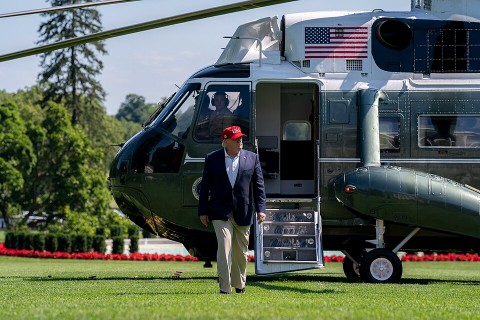
In a move that could potentially affect U.S.-China relations, President Donald Trump expressed his intention to speak with Taiwan’s President Lai Ching-te. This plan, revealed on Wednesday at Joint Base Andrews in Maryland, marks an unprecedented step for a U.S. leader. Trump emphasized his willingness to engage with various global leaders, stating, “I speak to everybody… We’ll work on that, the Taiwan problem.”
Since the United States shifted diplomatic recognition from Taipei to Beijing in 1979, direct conversations between U.S. and Taiwanese presidents have not occurred. However, Trump previously disrupted this precedent in 2016 by speaking with then-Taiwan President Tsai Ing-wen. This past interaction led to a formal complaint from China, which views Taiwan as a part of its territory and has not ruled out using force to assert control. The prospect of a new conversation with Taiwan’s leadership comes amid heightened tensions, as China has expressed discontent with ongoing U.S. military support for Taiwan.
The potential dialogue between Trump and Lai comes after Trump’s recent meeting with China’s President Xi Jinping. It is the second time Trump mentioned his intention to speak with Lai, dispelling doubts about whether his earlier comments were an error. Although no date for the conversation has been set, Trump’s administration has highlighted his approval of significant arms sales to Taiwan, surpassing previous U.S. presidents. Concurrently, Trump has referred to these sales as a “very good negotiating chip,” leaving the future of a major $14 billion weapons sale to Taiwan uncertain.
China has reportedly delayed approving a visit to Beijing by Elbridge Colby, the Pentagon’s undersecretary of defense for policy, as leverage over the weapons deal. Meanwhile, Trump’s statements have created mixed messages for Taiwan. While Lai expressed a willingness to communicate with Trump, he also emphasized Taiwan’s commitment to maintaining stability across the Taiwan Strait and pointed to China’s military buildup as a threat to peace. Lai asserted Taiwan’s right to self-determination, remarking, “No country has the right to annex Taiwan. The people of Taiwan pursue a democratic and free way of life, and democracy and freedom should not be regarded as provocation.”
Taiwan holds significant strategic value for the United States, not only due to its geopolitical position but also economically. As the fourth-largest U.S. trading partner, Taiwan plays a critical role, particularly in exporting advanced semiconductors vital to the global economy. Under U.S. law, Washington is obliged to provide Taiwan with defensive capabilities, and bipartisan support from U.S. lawmakers has urged the continuation of arms sales to the island, despite China’s opposition.