
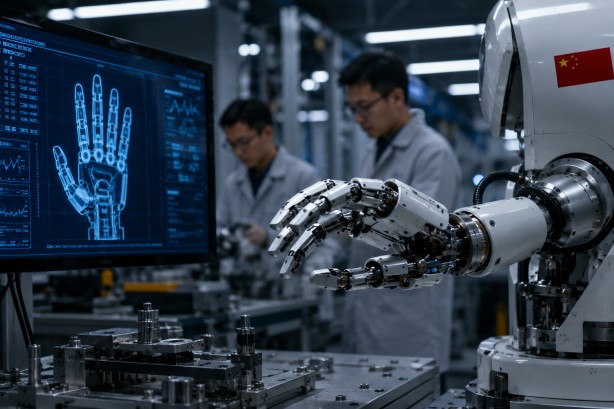
Chinese robotics firms are increasingly focused on overcoming one of the most significant hurdles in humanoid robot development: creating highly dexterous robotic hands. These companies are leveraging artificial intelligence alongside the nation’s robust manufacturing infrastructure to develop robotic hands that can handle delicate tasks such as gripping objects, tool usage, and managing everyday functions. This innovation is poised to be pivotal in making humanoid robots functional in domestic settings, healthcare environments, and industrial sectors.
Experts highlight that replicating the human hand’s flexibility and precision presents a far greater challenge than constructing other parts of a humanoid robot. Developers are tasked with addressing hardware issues like integrating compact motors and sensors, while also tackling software challenges that allow robots to interpret touch, pressure, and execute intricate movements.
China’s role as a global leader in robotics manufacturing is bolstered by its sophisticated supply chain and a government-supported emphasis on “embodied AI.” This burgeoning robotics ecosystem is fostering swift advancements, with companies not only innovating in robotic hands but also in developing wearable sensor gloves and AI systems that learn from human movements via real-world data.
Researchers anticipate that enhancements in robotic hand dexterity will be instrumental in enabling robots to perform a broad spectrum of daily activities. This progress could range from assisting with household chores to taking on industrial tasks and contributing to advanced prosthetic technology.
Industry leaders express confidence that ongoing improvements in AI and robotics might eventually lead to humanoid robots operating seamlessly alongside humans. Such progress would unlock new possibilities across manufacturing, healthcare, and consumer service industries, marking a significant leap forward in the practical application of robots in everyday life.