
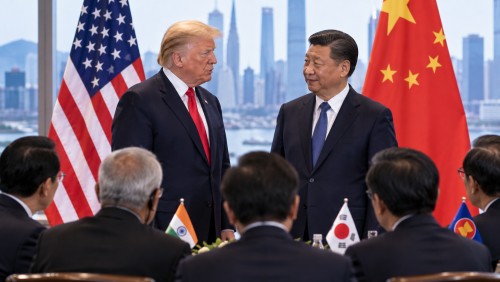
The upcoming meeting between U.S. President Donald Trump and Chinese President Xi Jinping has significant implications for regional stability in Asia, particularly concerning Taiwan. Allies such as Taiwan and Japan are on high alert, fearing that shifts in U.S. policy could destabilize the region and impact global semiconductor supply chains.
Taiwanese officials have been proactive in voicing their concerns to U.S. counterparts, anticipating that President Xi will bring up Taiwan during the discussions with President Trump. The U.S. has historically maintained a delicate stance on Taiwan, acknowledging Beijing’s claim without officially endorsing it, while continuing unofficial relations and defense support with the island.
Japan, a key U.S. ally, is also closely monitoring the situation. Tokyo has expressed its desire for Washington to uphold the established diplomatic language regarding Taiwan, to prevent any escalation of tensions in the region. Japanese officials are seeking ways for Prime Minister Sanae Takaichi to engage in dialogue with President Trump before the summit.
The issue of U.S. arms sales to Taiwan looms large over the talks. President Trump has previously hinted at using a proposed arms package as a bargaining chip in negotiations with China. This proposal has yet to receive final approval, and its potential use as leverage is a point of contention, given China’s firm opposition to U.S. military support for Taiwan.
While the primary focus of the Trump-Xi meeting is expected to be on U.S.-China economic relations, the discussion over Taiwan remains a crucial concern for Washington’s Asian allies. The outcome could have far-reaching consequences for regional security and the complex web of international relations in East Asia.