
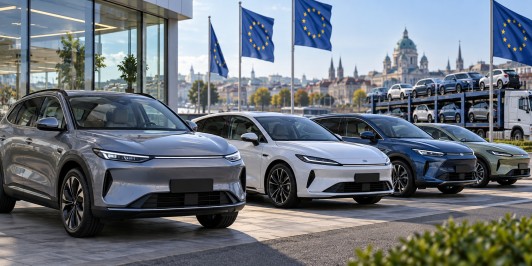
The European automotive landscape is facing significant shifts as the influx of Chinese-made hybrid cars reshapes market dynamics, posing a competitive challenge to local manufacturers. The surge in sales of these vehicles is not only increasing China’s footprint in the EU market but also prompting regulatory concerns and potential trade measures from Brussels.
A dramatic rise in sales of Chinese-made hybrid cars has been recorded, with fully hybrid vehicle sales skyrocketing from a mere 659 units in 2022 to 160,662 in the first seven months of 2026. Plug-in hybrids have also seen a substantial increase, growing from 56,706 units in 2022 to 217,764 in the same period this year. This growth has been facilitated by the absence of anti-subsidy tariffs on hybrids, in contrast to the tariffs placed on Chinese electric vehicles in 2024.
The European Commission, concerned about the growing market share of Chinese manufacturers, has urged China to voluntarily limit its hybrid vehicle exports to the EU. Without an agreement, the EU might resort to safeguard measures, including potential quotas, to protect its automotive industry. Currently, hybrid vehicles constitute nearly 37% of the European market, while fully electric vehicles account for just over 21%.
Chinese automotive groups such as BYD, Chery, Leapmotor, and Geely are swiftly gaining traction in Europe. BYD’s sales in the EU have reached approximately 177,000 vehicles, and Geely has sold around 205,000 vehicles in the first eight months of 2026. Despite this growth, European manufacturers still hold the largest overall market share, but the rapid rise of Chinese brands could alter this balance.
This increase in Chinese imports comes amid the EU’s efforts to address a growing trade imbalance with China and safeguard the competitiveness of its local automotive sector. The European Commission’s actions reflect a broader strategy to ensure fair competition and prevent market saturation by foreign entities in crucial industries.