
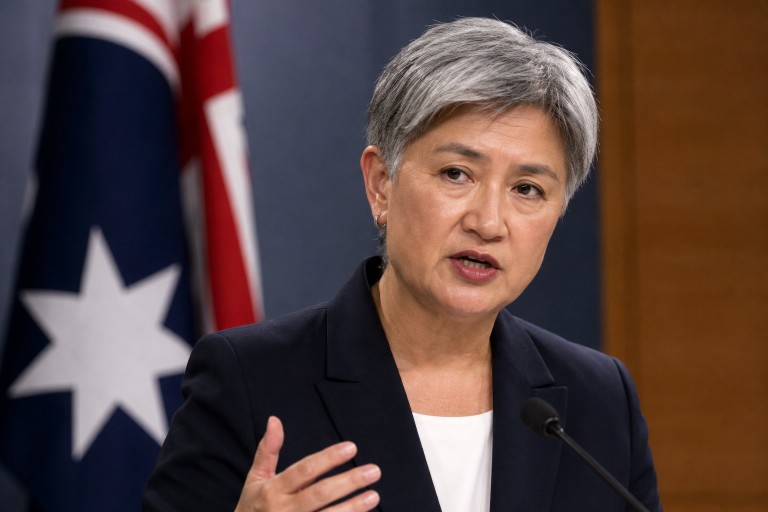
Australian Foreign Minister Penny Wong is poised to deliver a firm message against China’s “provocative” conduct, asserting that neither Australia nor its regional allies will succumb to intimidation. Addressing concerns over Beijing’s military growth and its actions in the Indo-Pacific, Wong’s comments come ahead of the ASEAN Foreign Ministers’ Meeting in the Philippines.
In her speech, Wong is expected to criticize China’s recent test of a nuclear-capable submarine-launched missile in the South China Sea, highlighting the lack of transparency and advance notice surrounding the launch. She plans to emphasize the dangers posed by China’s swift military modernization and expanding nuclear capabilities, advocating for increased openness to uphold stability in the region.
These remarks follow a tense incident in the South China Sea, where the Philippines accused the China Coast Guard of using force against one of its sailors. Australia has expressed its concerns about actions that it considers a threat to the safety of vessels from the Philippines, Vietnam, Malaysia, and Indonesia. Wong’s statements are likely to underline Australia’s commitment to regional security and its stance against aggressive maritime behavior.
Beyond immediate regional issues, Wong is also set to caution against potential disruptions in the Strait of Hormuz, a crucial maritime route. She will warn that instability there could significantly impact energy supplies, trade, and food security throughout the Indo-Pacific. The importance of keeping international sea lanes open will be a key point, as many countries in the region rely heavily on unimpeded maritime trade for essential goods such as fuel and fertilizers.
Australia’s dedication to collaborating with ASEAN partners to enhance regional stability, secure supply chains, and bolster economic resilience amid escalating geopolitical tensions will be reaffirmed. Wong’s anticipated address underscores the need for collective action and transparency to navigate the complexities of the current geopolitical landscape.