
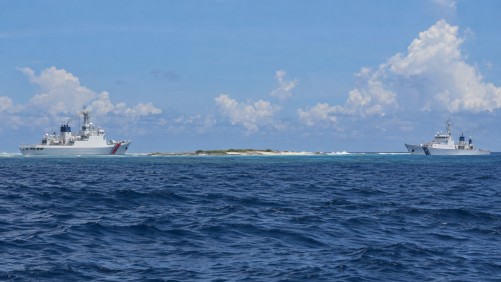
China has urged the Philippines to cease what it calls provocative actions in the South China Sea, emphasizing that its coast guard will continue operations to defend its territorial sovereignty and maritime interests. This request follows a recent Philippine supply mission to Ren’ai Jiao, also known as Second Thomas Shoal, an area where a grounded Philippine vessel is located.
According to China, the Philippine vessel entered the disputed area despite prior warnings from Beijing. In response, China’s coast guard monitored the supply ship and issued warnings during the operation, which Beijing claims were conducted lawfully. The Chinese authorities have accused the Philippines of breaching commitments under the Declaration on the Conduct of Parties in the South China Sea, suggesting that such actions could threaten regional peace and stability.
Beijing has affirmed its intention to continue law-enforcement operations around Ren’ai Jiao and other areas of the Nansha Qundao, known internationally as the Spratly Islands, to protect what it considers its maritime rights. The ongoing tension highlights the complex and contested nature of territorial claims in the South China Sea, an area of strategic importance and rich in resources.
The South China Sea remains a focal point of geopolitical friction, with multiple countries asserting overlapping claims. China’s firm stance on its territorial claims has been met with resistance from neighboring countries, including the Philippines, which has sought to assert its own maritime claims in the face of Chinese opposition.
This latest development adds another layer to the ongoing disputes in the region, underscoring the delicate balance of maintaining peace while navigating competing national interests. As tensions persist, the international community continues to watch closely, aware of the potential implications for broader regional stability.